



Defence Minister Rajnath Singh on Friday lauded the Indian Navy’s high state of operational preparedness and its growing strategic role in safeguarding maritime security, asserting that secure sea lanes remain critical to ensuring global peace and economic prosperity.
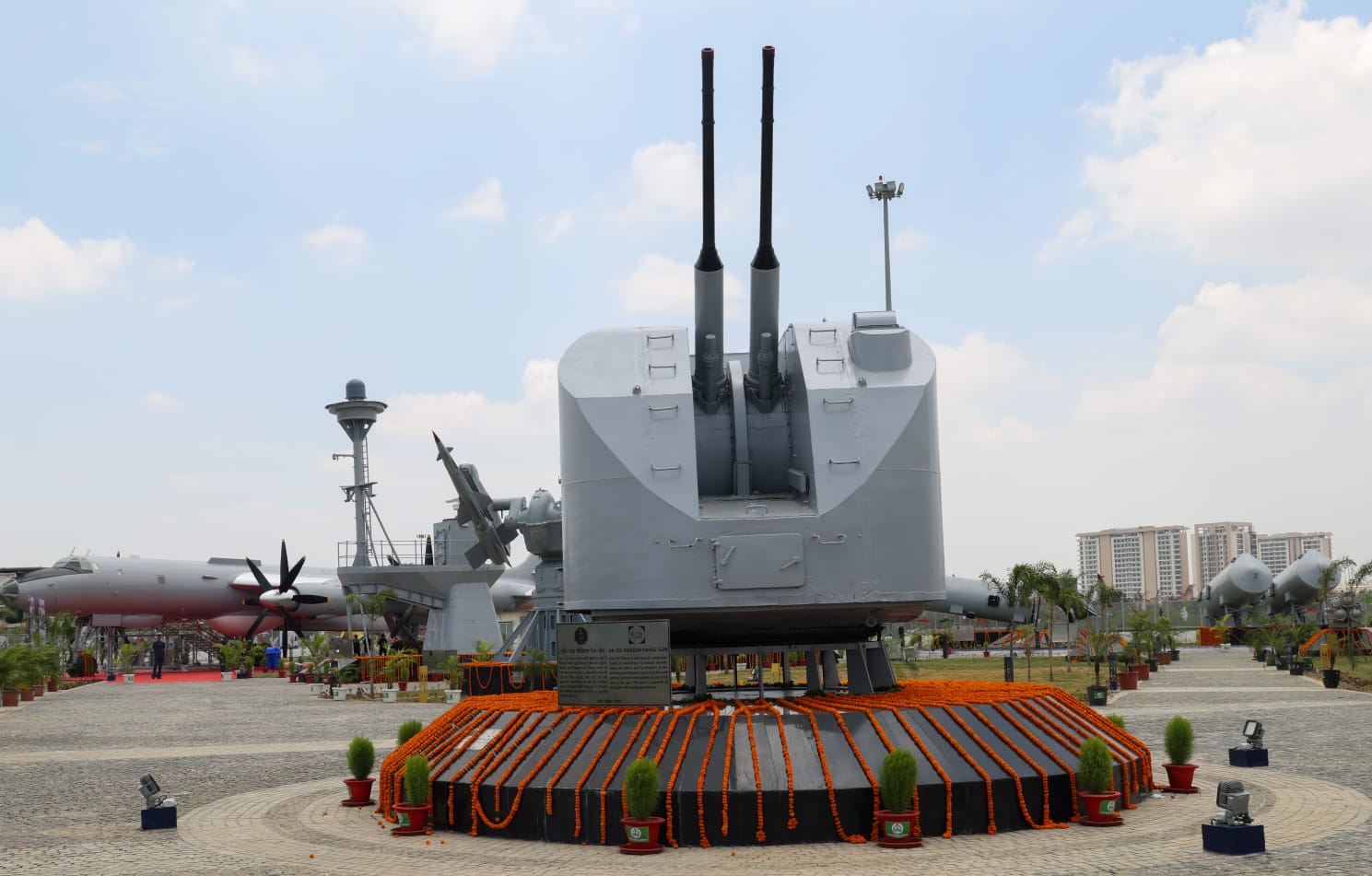
The Defence Minister made the remarks while jointly inaugurating the Nausena Shaurya Vatika with Uttar Pradesh Chief Minister Yogi Adityanath in Lucknow. Developed at a cost of ₹19 crore and spread across more than two acres, the open-air naval heritage museum commemorates the courage, professionalism and operational achievements of the Indian Navy. The facility prominently displays weapon systems and artefacts from the decommissioned guided-missile frigate INS Gomati, which served the nation for 34 years before being retired in May 2022.
Addressing the gathering, Singh described the Nausena Shaurya Vatika as more than a tourist destination, calling it a national symbol that would inspire future generations by highlighting the sacrifices made by the armed forces in safeguarding India’s sovereignty and security.
“This is not merely an architectural structure. It is a tribute to the dedication and sacrifice of our soldiers and a platform to inspire young citizens towards nation-building,” he said.
Navy’s Role in Operation Sindoor:
Highlighting the Indian Navy’s contribution to national security, the Defence Minister praised its performance during Operation Sindoor, noting that the Navy, alongside the Indian Army and Indian Air Force, played a crucial role in maintaining strategic pressure on Pakistan.
“Our Navy’s formidable deployment in the Arabian Sea created a constant deterrent effect on the adversary. The Pakistan Navy remained largely confined to its ports,” Singh stated.
He emphasised that in the current geopolitical environment, maritime security has emerged as a key pillar of international stability, making strong naval capabilities indispensable for protecting global trade routes and ensuring uninterrupted economic activity.
Push for Defence Self-Reliance:
The Defence Minister reiterated the government’s commitment to strengthening India’s military capabilities through indigenous defence production and technological innovation under the vision of Aatmanirbhar Bharat.
He highlighted initiatives such as Make in India, Defence Industrial Corridors, Innovations for Defence Excellence (iDEX) and ADITI, which are driving the development and production of advanced defence systems within the country.
“India’s strength lies in ensuring that its armed forces are equipped with domestically developed weapon systems. We are steadily moving from being one of the world’s largest importers of defence equipment to becoming a significant defence exporter,” he said.
According to Singh, India’s defence production has risen from approximately ₹46,000 crore in 2014 to over ₹1.51 lakh crore today and is expected to cross ₹1.75 lakh crore in the near future. Defence exports have also witnessed substantial growth, increasing from less than ₹1,000 crore in 2014 to nearly ₹40,000 crore.
Uttar Pradesh Emerging as Defence Manufacturing Hub:
Underscoring Uttar Pradesh’s contribution to the country’s defence ecosystem, Singh noted that the state is playing a key role through the Defence Industrial Corridor, which is helping build a robust domestic manufacturing base while generating employment and investment opportunities.
He added that the state has simultaneously made significant progress in sectors including infrastructure, healthcare, education, agriculture, trade and technology.
Nausena Shaurya Vatika Showcases Naval Heritage:
The newly inaugurated park features an extensive collection of naval weapon systems and artefacts, including the AK-726 naval gun, ZIF-101 surface-to-air missile launcher, anti-ship missile systems, radar equipment, torpedo launchers, anchors and ship masts recovered from INS Gomati.
A major attraction of the complex is a walkthrough museum built around the retired TU-142M long-range maritime reconnaissance aircraft, providing visitors with insights into India’s naval aviation history.
Developed under Phase-II of the Nausena Shaurya Sangrahalaya project, the facility also includes a food court, souvenir shop and modern lighting and sound installations for visitors.
Legacy of INS Gomati:
Commissioned on 16 April 1988 at Mazagon Dock Limited, INS Gomati was the third vessel of the Godavari-class guided-missile frigates and became one of the longest-serving frontline warships of the Indian Navy.
Throughout its distinguished service, the frigate participated in major operations including Operation Cactus, Operation Parakram and Operation Rainbow, besides taking part in numerous bilateral and multinational naval exercises.
Recognising its outstanding operational performance and contribution to maritime security, INS Gomati received the prestigious Unit Citation twice — in 2007-08 and again in 2019-20 — before being decommissioned in May 2022 after more than three decades of service.
Chief of the Naval Staff Admiral Dinesh K. Tripathi, along with senior civil and military officials, attended the inauguration ceremony.
