



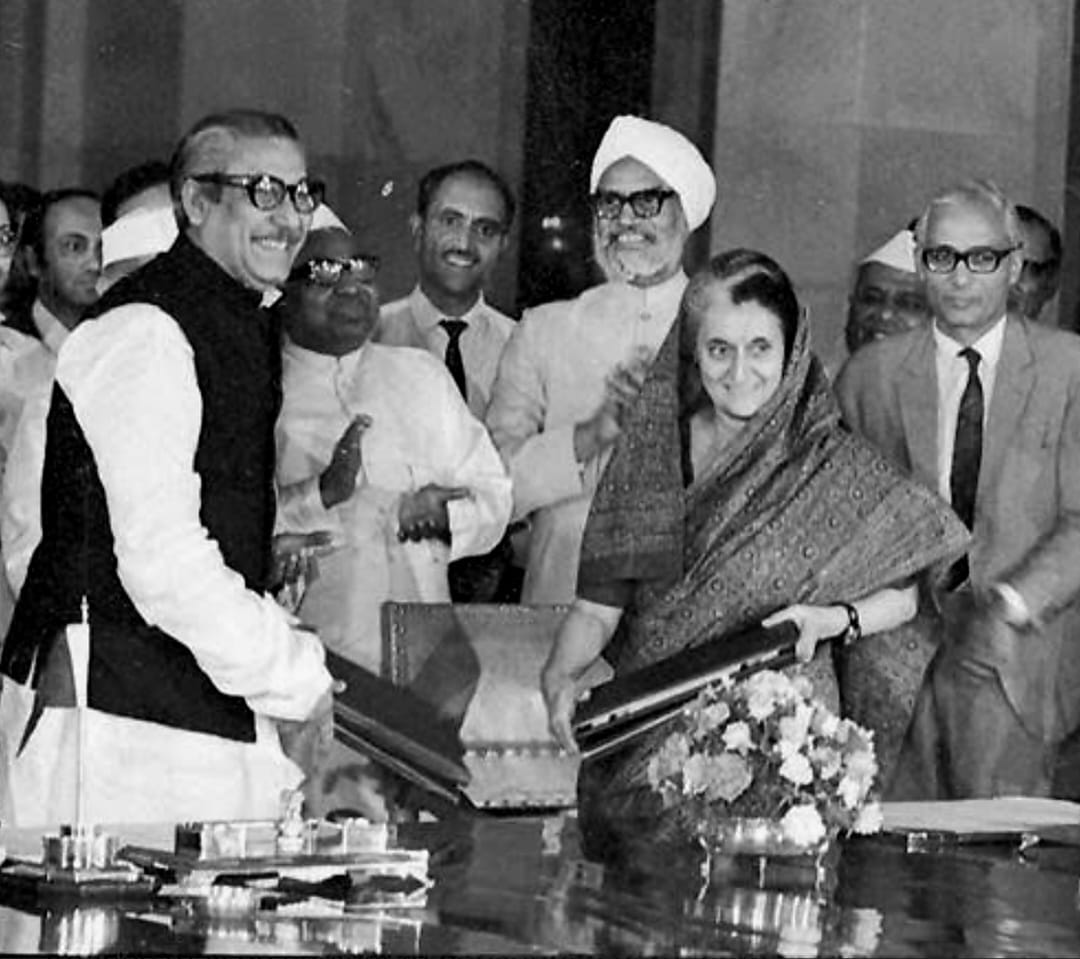
March 19 is historically significant as the day, the India-Bangladesh Treaty of Friendship, Co-operation and Peace was signed in 1972, often noted for marking a key era in bilateral relations.
The relationship between India and Bangladesh has evolved into one of the most significant partnerships in South Asia. Rooted in shared history, cultural ties, and mutual respect, this bond has grown stronger over decades, particularly since the signing of the key agreements that laid the foundation for long-term co-operation.
India played a crucial, multi-faceted role in supporting Bangladesh immediately after its independence in December 1971, as a key partner in its political, social, and physical reconstruction. This support was built on the foundation of shared sacrifices during the Bangladesh Liberation War.
KEY ASPECTS OF INDIA’S ROLE AFTER 1971:
After the 1971 war, India played a key role in supporting Bangladesh’s political, social, and economic transition. It was the first country to recognize Bangladesh as an independent state and helped establish a stable government by ensuring the return of Sheikh Mujibur Rahman. India also assisted in the repatriation of around 10 million refugees and supported the country’s commitment to secularism and democracy.
In terms of nation-building, India contributed to rebuilding the country’s infrastructure, helped organize and train the Mukti Bahini into a formal military structure, and provided economic aid to address the severe post-war challenges.
A 25-YEAR TREATY AND ITS IMPACT :
One of the most important milestones in bilateral relations was the signing of the Indo-Bangladesh Treaty of Friendship, Co-operation and Peace. This treaty, designed over a duration of 25 years, remained active until 1997. It symbolized a commitment to peace, stability, and co-operation between the two nations. During this period, both countries worked closely on political, economic, and security matters, reinforcing a sense of trust that continues to define their relationship.
DEVELOPMENT AND HUMANITARIAN SUPPORT:
India has consistently extended support to Bangladesh in times of need. During natural disasters such as Cyclone Aila and Cyclone Amphan, India provided humanitarian assistance, demonstrating solidarity and regional responsibility.
Beyond emergency aid, India has contributed to Bangladesh’s development through infrastructure and energy initiatives. A notable example is the India-Bangladesh Friendship Pipeline, which enhances energy connectivity between the two countries. India has also played a crucial role in strengthening Bangladesh’s power and energy sectors, helping to support its growing economy.
WATER AND ENERGY CO-OPERATION:
Water sharing has been a vital role in building up the bilateral relations.The Ganges Water Sharing Treaty stands as a landmark agreement ensuring equitable distribution of water resources, particularly during the dry season.
In the energy sector, collaborative projects like the Maitree Super Thermal Power Project highlight the depth of such co-operation. These initiatives not only address energy needs but also strengthen economic ties and regional integration.
CONTINUED PARTNERSHIP BEYOND PARTNERSHIP 1997:
Even after the treaty expired in 1997, the relationship between India and Bangladesh did not lose momentum.Instead, it evolved into a more dynamic partnership. Both the countries continued to collaborate on trade, border security, counter-terrorism, and regional stability.
Regular high-level exchanges and agreements have ensured that co-operation remains relevant and forward-looking, adapting to new challenges and opportunities.
RESPECT FOR SOVEREIGNTY —
COMMITMENT TO NON-INTERFERENCE:
The 1972 Treaty explicitly recognized the sovereignty, territorial integrity, and non-interference in the internal affairs of both the nations.
WITHDRAWAL OF TROOPS:
In a major show of goodwill, India withdrew its armed forces from Bangladesh in March 1972, ahead of the agreed deadline, following a farewell parade in Dhaka.
BILATERAL FOCUS:
Both nations pledged to reduce the differences and shared resources through bilateral negotiations.
AN ENDURING FRIENDSHIP:
The India–Bangladesh relationship is built on a strong foundation of trust, mutual respect, and shared progress.Over the years, India has proven to be a reliable partner, standing by Bangladesh during crisis and supporting its development journey.
As both the nations look forward to the future, their partnership is expected to deepen further, contributing not only to their own growth but also to the stability and prosperity of the entire South Asian region.
FUTURE AHEAD:
Based on the latest reports as of March 17, 2026, the following developments are taking place between India and Bangladesh.
ENERGY SUPPLY – DIESEL IMPORTS:
Bangladesh is receiving a shipment of 5,000 tonnes of diesel from India via the Bangladesh-India Friendship Pipeline around March 18-19, 2026, as part of efforts to stabilize fuel supplies for festival holidays, as per reports in an Indian News paper.
ECONOMIC & ENERGY CO-OPERATION:
Following meetings on March 16, 2026, both the countries are focusing on enhancing connectivity, reviewing the Line of Control (LOC), and exploring Bangladesh’s participation in India’s power exchange market, according to a leading Indian News Agency.
STRATEGIC REALITY:
Geo – political situation plays a big role.Bangladesh is almost surrounded by India and hence maintaining a professional working relation, acknowledging the huge sacrifices of Indian Armed Forces during their Liberation War is always necessary in their own interest.
Now time will tell what will be the stand of Bangladesh.Will they maintain healthy relation with India as a good neighbour or they will think otherwise?
(All articles are original works of Ms.Pratyusha Mukherjee, and some news media also shared the same. Any modification or usage needs to be approved by her only)
