



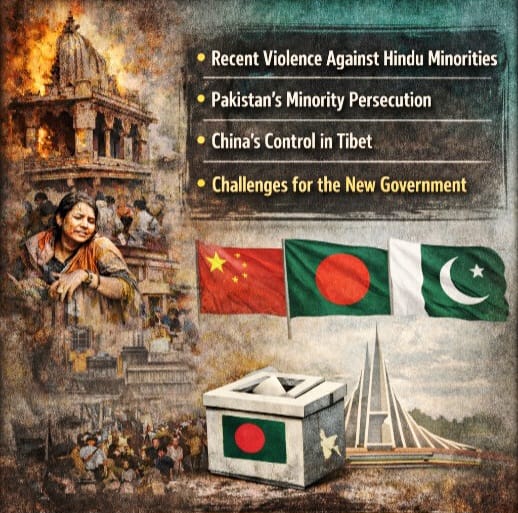
Over the past two years, Bangladesh has faced renewed scrutiny over incidents affecting minority communities, particularly Hindus. Political transitions and elections often heighten sensitivities, but developments between 2024 and early 2026 have raised deeper concerns about whether these episodes represent isolated unrest or signal a troubling pattern. Following the upheaval of August 2024, human rights monitors documented widespread reports of vandalism, intimidation, and attacks on temples, homes, and businesses linked to minority groups. The recurrence of such incidents during politically charged periods has intensified questions about the adequacy of protections for vulnerable citizens.
Among the most disturbing cases was the December 2025 lynching of Dipu Chandra Das, a 27-year-old garment worker in Bhaluka. The brutality of the mob attack drew strong reactions from civil society and underscored the fragility of communal harmony. Soon after, in early 2026, the killing of Sushen Chandra Sarkar, a 62-year-old trader in Mymensingh just days before national elections, amplified fears that minorities may face heightened risks during moments of political transition.
These concerns deepened further on 12 February 2026, when a 28-year-old Hindu tea garden worker was found dead on the morning of Bangladesh’s parliamentary elections. Initial reports cited visible injury marks, prompting anxiety within the local minority community. The incident occurred as voting was underway nationwide, intensifying apprehensions about safety during a politically sensitive period. While activists described the timing as alarming, law enforcement authorities stated that investigations were underway and cautioned against premature conclusions. Nevertheless, civil society groups viewed the episode as part of a broader climate of insecurity.
The previous interim government under Chief Adviser Muhammad Yunus emphasised due process and urged restraint in attributing communal motives without verified findings. Officials framed these incidents as criminal matters subject to investigation. However, the emotional tribute issued following the December 2025 killing of protest leader Usman Hadi introduced a contrasting tone. For some observers, this difference in public acknowledgment contributed to perceptions of inconsistency in state messaging.
In a geopolitically sensitive region, internal instability can intersect with external influences whether ideological, political, or strategic. Prolonged minority insecurity in Bangladesh will fuel social unrest and gradually affect demographic confidence and migration patterns.
The Greater risk lies in further persecution of minorities, blaming for not voting to extremist forces during recently concluded election in BD.
With the Bangladesh Nationalist Party (BNP) having formed the new government following the elections, the country stands at an important juncture. The incoming administration will face the dual challenge of restoring public confidence and ensuring visible, impartial protection for all communities. Beyond economic priorities, reinforcing social cohesion and institutional neutrality will be critical in the post-election phase. Any further incidents of violence against minorities during this transition period could risk creating instability and placing additional pressure on the new government.
Bangladesh was founded on principles of pluralism and cultural identity. Preserving that legacy requires consistent and equal protection under the law. From a demographic perspective—where demography refers to the composition, distribution, and movement of populations across regions and communities prolonged insecurity can have lasting consequences. When minority groups feel unsafe, migration patterns, settlement trends, and long-term population balance may gradually shift, reshaping the social fabric of the nation.The country’s future will therefore be determined not by comparisons with its neighbours, but by its ability to strengthen democratic institutions, protect all communities equally, and sustain demographic confidence. In that balance lies the true measure of stability.
CREATION OF BANGLADESH AND IT’S PLACE IN GLOBAL MAP:
In 1971, the Indian Army brought Pakistani Army to its knees and gave 75 million people of Bangladesh their independence.
The war, which continued for 13 days, ended with the surrender of 93,000 Pakistani soldiers — the largest surrender by an Army since World War-II. India won the war decisively — splitting Pakistan into two, with the creation of Bangladesh.
(Source based)
(Edited by Pratyusha Mukherjee)
