



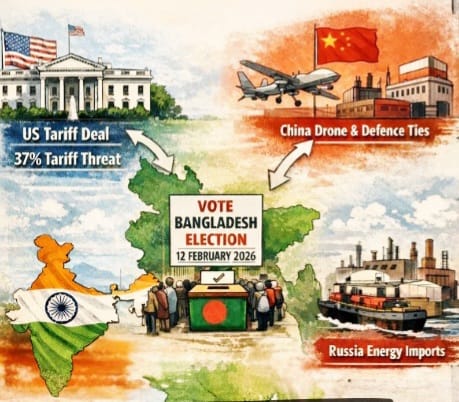
The United States’ newly signed reciprocal tariff agreement with Bangladesh has added a new layer of strategic pressure to Dhaka’s economic policymaking. While Washington reduced duties on Bangladeshi exports from 37% to 19% and offered zero reciprocal tariffs on garments made from US cotton and synthetic fibres, the relief is conditional.If Bangladesh signs a new trade agreement with a “non-market economy,” the US can terminate the deal and restore the 37% tariff. With China and Russia falling under that classification, Dhaka’s future economic engagements are now directly linked to Washington’s approval.
This clause could complicate Bangladesh’s ambition to integrate into wider trade groupings such as the Regional Comprehensive Economic Partnership, where China is a central member.
Alongside tariff concessions, Bangladesh has committed to regulatory reforms, stronger intellectual property rules and major commercial purchases including Boeing aircraft, LNG, wheat, soy and cotton aimed at narrowing the US trade deficit. The arrangement, therefore, offers Bangladesh short-term export relief but limits its strategic flexibility.
These developments coincide with Bangladesh’s political transition following the 12 February 2026 election. The incoming government inherits a delicate balancing act: managing US tariff conditionalities, maintaining defence and technological cooperation with China including drone manufacturing initiatives and sustaining energy linkages with Russia, all while ensuring economic stability at home.
GEO POLITICAL RELATION BETWEEN INDIA AND BANGLADESH:
India is Bangladesh’s immediate geographical neighbour.This evolving scenario carries long-term strategic implications for India. Geography ensures that connectivity, transit, border management and energy flows bind the two countries in ways that go beyond transactional trade arrangements. Over the past decade, India and Bangladesh have concluded landmark agreements such as the 2015 Land Boundary Agreement, expanded rail and road connectivity, opened access to Chittagong and Mongla ports for India’s northeastern states, operationalised the India–Bangladesh Friendship Pipeline, and strengthened electricity trade. India has also extended over $8 billion in lines of credit, making it Bangladesh’s largest development partner.
From an economic perspective, US tariff concessions may provide Bangladesh with immediate gains in the textile sector. However, India has steadily moved toward greater self-sufficiency in textiles and manufacturing. In the Union Budget 2026, the Government of India allocated additional funds to boost domestic textile production and value-added manufacturing under its industrial development push. This reduces India’s structural dependence on Bangladeshi textile imports. In practical terms, even if bilateral textile trade fluctuates, the impact on India would likely be limited.For Bangladesh, however, access to India’s large and proximate market along with seamless logistics and energy connectivity offers sustained and predictable benefits.
India’s approach toward Bangladesh has consistently reflected its “Neighbourhood First” policy. Budgetary allocations for foreign assistance to friendly neighbouring countries reaffirm New Delhi’s intent to anchor regional stability through development partnerships rather than coercive economic tools.
Unlike tariff-based leverage, India’s engagement model has focused on infrastructure development, power cooperation, market access and security coordination — measures that generate long-term interdependence.
The current geopolitical churn may offer Bangladesh short-term economic advantages through US trade adjustments, but geography and integrated supply chains underscore the enduring logic of strong India–Bangladesh ties. As Dhaka navigates tariff pressures from Washington and strategic engagement with Beijing and Moscow, the long-term calculus suggests that stable, mutually beneficial cooperation with India remains its most sustainable option.
(Source based)
