



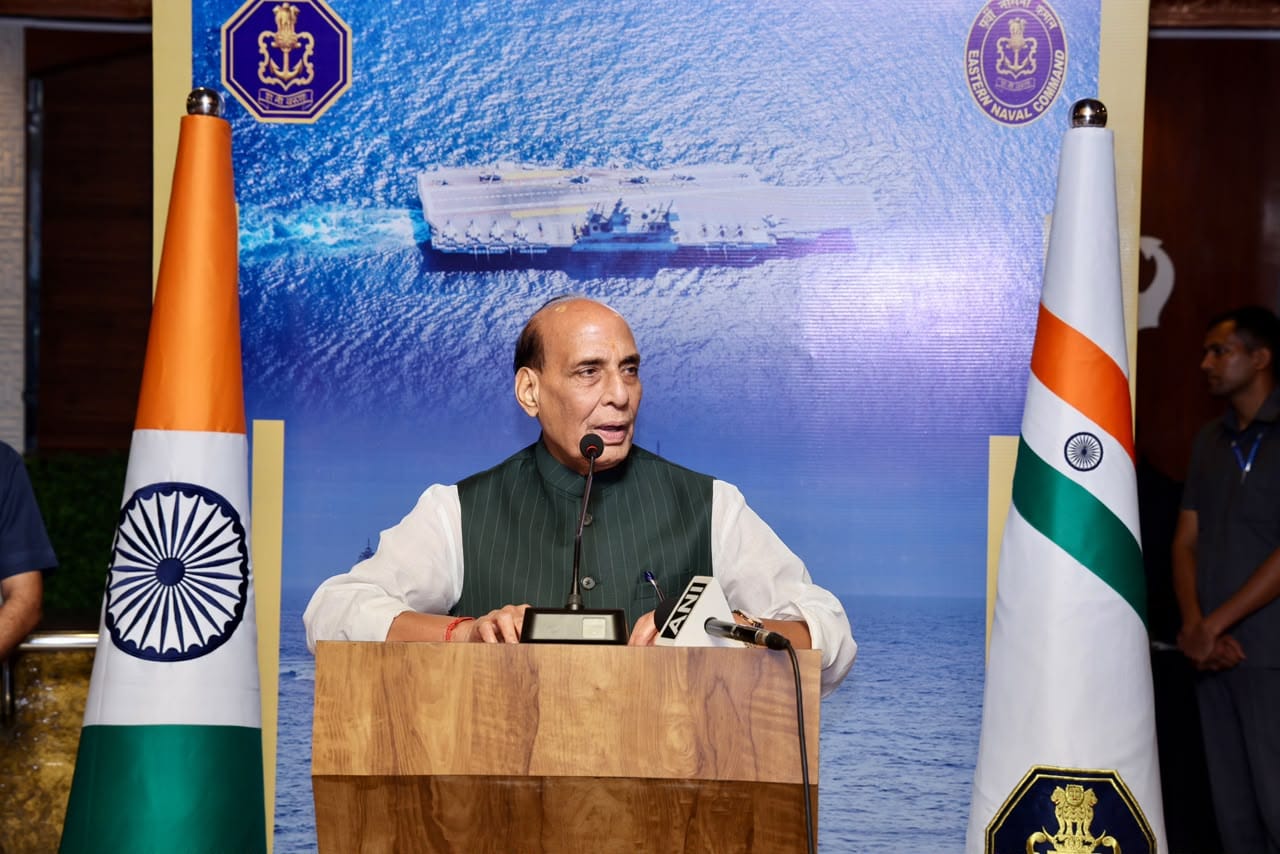
Rajnath Singh today described India as a key pillar of peace and stability in the Indian Ocean Region, praising the Indian Navy for protecting the nation’s maritime interests and ensuring the presence of the Tricolour across the region amid a rapidly evolving global security landscape.
Addressing naval personnel at Barakhana in Visakhapatnam ahead of the commissioning of Mahendragiri, the sixth Project 17A indigenous stealth frigate, the Defence Minister highlighted the critical role of maritime security in safeguarding India’s economic and strategic interests.
He stated that more than 90 per cent of India’s trade by volume is conducted through maritime routes, while energy security, the Exclusive Economic Zone and island territories make the protection of the seas vital for national growth and security.
The Defence Minister noted that increasing geopolitical competition and the growing presence of extra-regional forces in the Indian Ocean Region have made maritime vigilance more important than ever. He said the Indian Navy continues to secure vital sea lanes, protect maritime boundaries and safeguard India’s interests across the region.
Calling India the largest and most responsible stakeholder in the Indian Ocean Region, Shri Rajnath Singh reaffirmed the country’s commitment to maintaining peace, stability and a secure maritime environment. “The region is our courtyard, and securing the courtyard is our responsibility,” he said.
Highlighting India’s progress towards self-reliance in defence manufacturing, the Defence Minister said the commissioning of Mahendragiri reflects the nation’s expanding indigenous defence capabilities. He credited the courage, dedication and patriotism of India’s armed forces for protecting the country from emerging threats and challenges.
He called upon military personnel to continuously enhance their skills, adopt advanced technologies and remain prepared for the changing nature of warfare. The Defence Minister cautioned that future conflicts could emerge in unexpected forms and may not always follow traditional patterns.
“There are conflicts that are fought without a formal declaration of war. The adversary of tomorrow may not look like the adversary of the past,” he said, adding that the government would continue to ensure that the armed forces receive the best available weapons, technology and resources.
Emphasising the importance of human capability alongside military equipment, Shri Rajnath Singh said that while modern weapons are essential, it is the determination, training and resolve of soldiers that ultimately decide the outcome of conflicts.
Chief of the Naval Staff Admiral Krishna Swaminathan, Flag Officer Commanding-in-Chief, Eastern Naval Command Vice Admiral Sanjay Bhalla and other senior officers of the Indian Navy were present on the occasion.
