



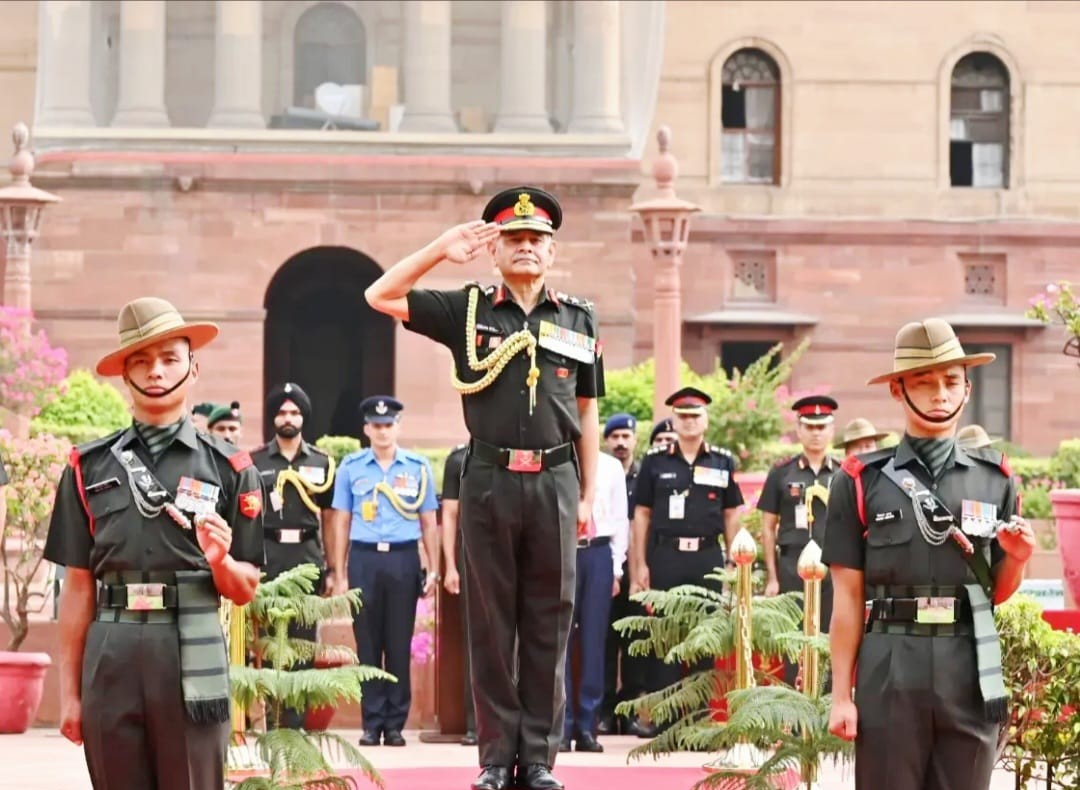
General Upendra Dwivedi, PVSM, AVSM, demitted office as the Chief of the Army Staff (COAS) on Tuesday upon attaining superannuation, bringing to a close a distinguished military career spanning more than four decades in the service of the nation.
His tenure as the 30th Chief of the Army Staff was marked by a strong emphasis on operational preparedness, organisational transformation, technological modernisation and enhanced jointness among the Armed Forces. Under his leadership, the Indian Army pursued comprehensive reforms aimed at building a future-ready, technology-driven and agile force capable of addressing emerging security challenges.
General Dwivedi maintained a high state of operational readiness across all theatres during a period of evolving regional security dynamics. The Indian Army sustained a robust and vigilant posture along the Northern Borders under Operation Snow Leopard, while continuing to execute its responsibilities along the Western Front with professionalism, restraint and operational effectiveness.
One of the defining milestones of his tenure was Operation Sindoor, which demonstrated the Army’s preparedness, precision and calibrated response to contemporary security challenges. The operation underscored the Indian Army’s ability to execute complex missions while maintaining strategic stability.
As part of the Army’s ongoing Decade of Transformation, General Dwivedi spearheaded wide-ranging reforms focused on force restructuring, capability enhancement, technological integration and institutional modernisation. His leadership accelerated the induction of advanced technologies, strengthened operational flexibility and promoted reforms in human resource management and organisational efficiency.
Several transformational initiatives gathered momentum during his tenure, including the operationalisation of Rudra Brigades, Bhairav Battalions, Ashni Drone Platoons, Shaktibaan Regiments, Divyastra Batteries, Electronic Warfare Brigades and Integrated Battle Groups. These initiatives are expected to significantly enhance the Indian Army’s combat effectiveness and preparedness for future multi-domain warfare.
Recognising the importance of integrated military operations, General Dwivedi consistently advocated greater synergy among the Army, Navy and Air Force. His tenure witnessed sustained efforts towards strengthening joint operational planning, interoperability and theatre-oriented military capabilities in line with India’s evolving defence strategy.
Beyond operational and organisational reforms, General Dwivedi remained deeply committed to the welfare of serving soldiers, veterans, Veer Naris and military families. He introduced several soldier-centric initiatives aimed at improving welfare, strengthening institutional support and recognising the invaluable contributions of veterans through programmes such as the Veterans Achievers Award. He consistently emphasised that the Army’s commitment to its personnel extends well beyond their active years of service.
Providing a long-term strategic vision, General Dwivedi also guided the formulation of the Strategic Security Guidelines @2047, aligned with the national vision of Viksit Bharat @2047 and the Armed Forces Vision @2047. The framework seeks to prepare the Indian Army for future security challenges through sustained modernisation, technological innovation and integrated force development.
For his exceptional service to the nation, General Upendra Dwivedi has been decorated with the Param Vishisht Seva Medal (PVSM) and the Ati Vishisht Seva Medal (AVSM).
As he concludes his tenure, General Upendra Dwivedi leaves behind a legacy of operational excellence, transformational leadership and institutional reform, having steered the Indian Army through a critical phase of modernisation while reinforcing its commitment to national security and the welfare of its personnel.
